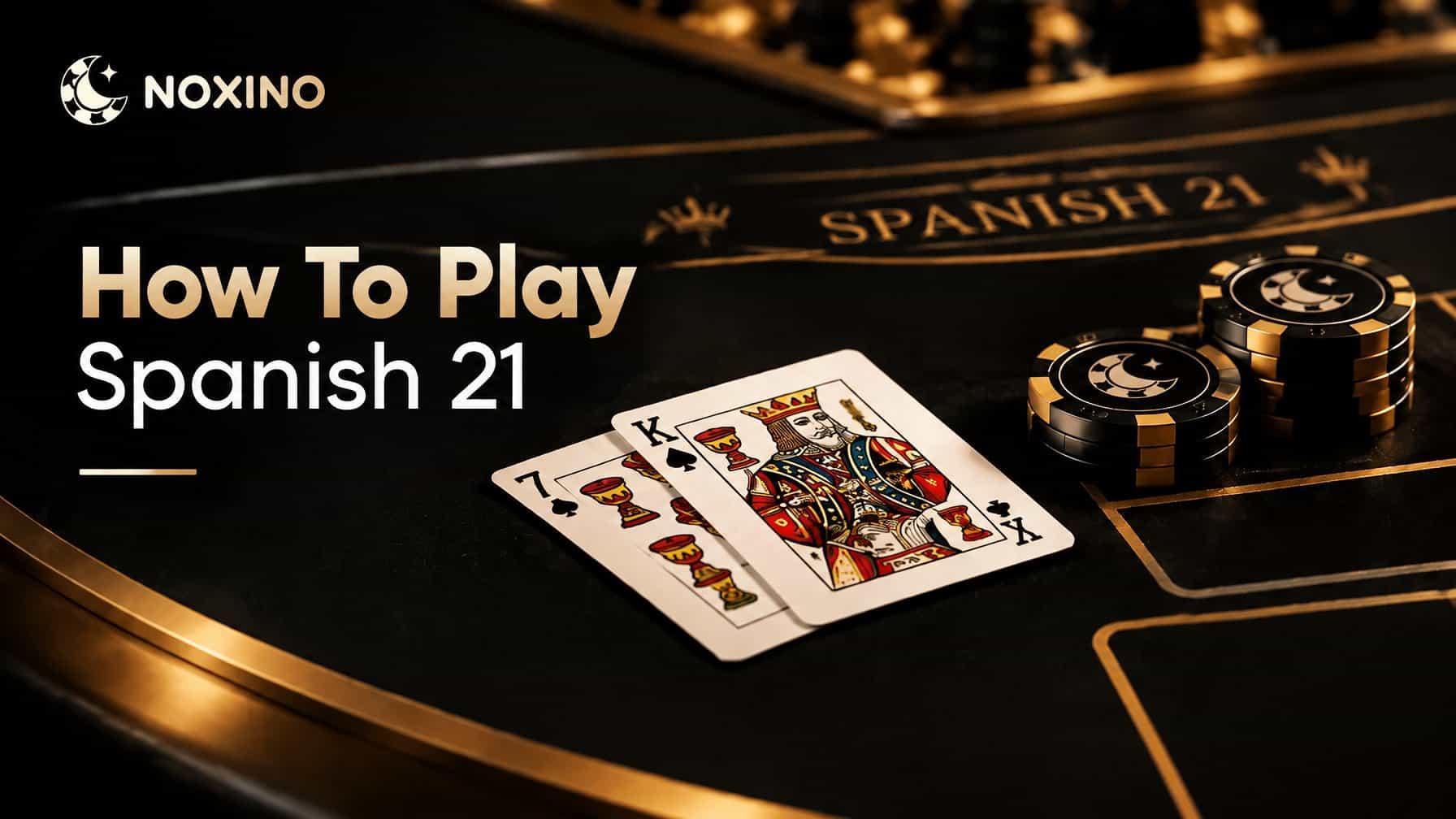
Spanish 21 may sound straightforward to blackjack fans, but a familiar-looking table can still catch you off guard after just a hand or two. The deck and a few key rules work differently, and some hands can unlock extra payouts.
This guide starts with the rule changes to watch for, then explains how to make sense of the bonus payout table, and finally looks at the odds. If you’re browsing the game selection at Noxino Casino, these basics can help you know what to check before you play.
A Plain-Language Look at Spanish 21
Think of Spanish 21 as blackjack’s close cousin: you and the dealer each try to get nearer to 21 without going over. If your total beats the dealer’s, or the dealer busts, you win the hand. The familiar aim comes with a few rule changes, so it pays to check the table rules before you play.
Spanish 21 may also offer extra payouts for certain hands; those are part of the game, not the same as promotions at Noxino. Check Noxino’s current offers separately, since promotions can change and may have their own terms.
The Cards Missing From a Spanish Deck
A Spanish 21 deck has 48 cards. The four 10s are removed, but jacks, queens and kings stay in the deck and still count as 10. That means there are fewer 10-value cards than in regular blackjack, which can affect the totals players and the dealer draw.
Aces still count as 1 or 11. For the exact deck and rules at your table, check the casino’s game information or ask the dealer.
Goal, Deal and Play: A Round of Spanish 21
The goal is to finish closer to 21 than the dealer without going over. A typical round follows these steps, though details can vary by casino:
- Place your bet. Wait until betting opens, then put your wager in the betting circle.
- Get your cards. You and the dealer receive two cards; usually, the dealer shows one card face up.
- Make your decisions. You act first, choosing from the options allowed by the table rules. The dealer’s upcard can help you judge the strength of your hand.
- Watch the dealer play. After players finish, the dealer follows the table’s rules for drawing or standing.
- Settle the hand. Winning bets and any qualifying bonuses are paid.
Once you know the flow, you can browse the casino game lineup for other table games you might enjoy.
Hit, Stand and Insurance at a Glance
Hit means ask for another card. Stand means keep your current total and end your turn.
Insurance is an optional side wager sometimes offered when the dealer’s upcard is an ace. It bets that the dealer has a natural blackjack. Availability and rules vary, so check the table information before assuming you can take it, or deciding whether it suits your play.
Bonus Payouts and the Hands Behind Them
Some Spanish 21 tables pay extra when you make 21 with several cards or hold a qualifying 6-7-8 or 7-7-7 combination. The exact cards, suit requirements and amounts depend on the casino, so there isn’t one universal payout chart.
The table below shows common example payouts, not guaranteed rules. Check the pay table at your casino before betting; suits usually need to match the listed condition, and the payout may be a bonus on top of the regular hand result.
| Bonus Hand | Pays | Notes |
| 5-card 21 | 3:2 | Hand totals 21 with five cards |
| 6-card 21 | 2:1 | Hand totals 21 with six cards |
| 7+ card 21 | 3:1 | Hand totals 21 with seven or more cards |
| 6-7-8 mixed suits | 3:2 | Three cards in different suits |
| 6-7-8 suited | 2:1 | All three cards share a suit |
| 6-7-8 spades | 3:1 | All three cards are spades |
| 7-7-7 mixed suits | 3:2 | Three sevens in different suits |
| 7-7-7 suited | 2:1 | Three sevens in the same suit |
| 7-7-7 spades | 3:1 | All three cards are spades |
These are illustrative figures, not verified payouts for every game. A posted table may use different amounts or conditions, so always follow the casino’s own pay table.
Super Bonus: Not a Casino Promotion
A Super Bonus is a special Spanish 21 payout for a qualifying hand. At some tables, the dealer’s cards also affect whether it pays. The winning hand, dealer condition and payout can vary, so check the table’s pay chart before you play.
This in-game reward is separate from a casino welcome offer. Looking for a 100% welcome bonus? Visit the link to review the offer and its terms.
Envy Bonus and Who Receives It
An Envy Bonus can give players at the table a little reason to cheer when someone lands a qualifying hand. The player who makes the hand gets their payout, and eligible players nearby may receive an extra payment too.
Rules and amounts vary, and some casinos don’t offer Envy at all. Check the table rules to see who qualifies.
Rule Differences to Learn Before You Play
Spanish 21 rules can change what you’re allowed to do and how a hand is settled. The points below cover common rule features, but none are guaranteed at every table.
Always check the casino’s own rule sheet or ask the dealer before betting. The posted rules decide what applies.
Splitting Pairs: Limits and Aces
When you’re dealt a pair, many Spanish 21 tables let you split it into two hands by placing a second bet equal to your first. Some tables allow several resplits; others set a firm limit.
Aces often come with extra restrictions. A casino may let you split them but deal only one card to each new hand, while another table may allow more options. Check how many times you can split and what actions are allowed afterward.
Doubling Down and Its Limits Here
Doubling down means adding a second wager, usually equal to your original bet, in return for one more card. Some Spanish 21 tables let you double on any first two cards, while others limit the totals that qualify.
A notable feature at many tables is the option to double after splitting. That can differ from blackjack games where doubling after a split is restricted. Rules vary, so confirm which hands qualify and whether the option applies to split aces.
Double Down Rescue: Reversing a Double
Double Down Rescue is an optional rule at some Spanish 21 tables. After doubling and receiving one card, you may be allowed to give up the doubled hand and recover the extra wager. Your original bet is still at risk.
For example, you bet $10, double for another $10, then receive a card that leaves you with a weak total. If Rescue is allowed, you could forfeit the added $10 and keep playing with the original wager at stake. Check when the choice must be made.
Surrender: Leaving a Hand Early
Surrender lets you give up a hand before taking more cards, usually losing half your original bet and getting the rest back. At some tables, you must signal the dealer before acting on your hand.
A common exception applies when the dealer has a natural blackjack: surrender may not be available after that hand is confirmed. Check the table rules for timing and eligibility.
How Blackjack Pays at a Spanish 21 Table
A natural blackjack, an ace and a 10-value card as your first two cards, often pays more than an ordinary win, but the exact payout depends on the table. In Spanish 21, the 10-value card is a face card because the 10s are removed.
Check the pay table to see the natural payout and how it compares with a dealer blackjack. Don’t assume the rules match another casino’s game.
A Player 21 Against a Dealer 21
At many Spanish 21 tables, a player’s 21 beats the dealer’s 21, rather than pushing as it often does in standard blackjack. That can make drawing to 21 feel different—but check the table rules before relying on it.
For example, if you make 21 with three cards and the dealer has 21 with two, your hand may win under that rule. The exact outcome can depend on the casino’s rules and how each 21 was made.
Match the Dealer: How the Side Wager Works
Want to add a little extra suspense before the main hand plays out? Match the Dealer is an optional side bet that pays when one of your first two cards matches the dealer’s face-up card in rank. For instance, your queen matches the dealer’s queen. Some tables offer a bigger payout if the cards also share a suit.
This bet stands on its own: it can win or lose regardless of your main hand. Before you place it, check which cards count, the payout chart, and the table’s minimum and maximum wagers. Rules vary by casino, so take a quick look before jumping in.
Matching Payouts From Weakest to Strongest
At Rivers Casino Philadelphia, Match the Dealer pays more as the matches become more specific or numerous. Here are the listed payouts, ordered from lowest to highest. Check your own table’s pay chart, as another casino may offer different payouts or conditions.
| Match Type | Pays | Casino Source |
| 1 non-suited match | 3:1 | Rivers Casino Philadelphia |
| 2 non-suited matches | 6:1 | Rivers Casino Philadelphia |
| 1 suited match | 2:1 | Rivers Casino Philadelphia |
| 1 non-suited and 1 suited match | 15:1 | Rivers Casino Philadelphia |
| 2 suited matches | 24:1 | Rivers Casino Philadelphia |
Table Etiquette and House Rules in Practice
At a live table, wait for the dealer to open betting before placing chips, and keep your hands clear once the cards are out. Use the table’s approved signals for hitting or standing—ask the dealer if you’re unsure, and make your decision before play moves on.
Bets usually lock when the dealer calls “no more bets” or begins the deal. Online, you can skip the hand signals and chip etiquette, but you still need to check the game rules and make each choice before the timer runs out.
Strategy That Fits the Spanish 21 Rules
A standard blackjack strategy chart may give you the wrong advice in Spanish 21. The missing 10s, bonus hands and player-friendly options can change the best move, so look for a chart made specifically for Spanish 21 and matched to your table’s rules.
A few smart habits help:
- Check rules such as dealer soft 17 and doubling after a split.
- Keep the correct strategy chart handy while learning.
- Set a budget before you start, and stick to it.
Good strategy can reduce the house edge, but it can’t remove it or guarantee a win. Treat every hand as uncertain, and play only what you can afford to lose.
Why Spanish 21 Rules Change From Casino to Casino
Spanish 21 tables can share a name yet offer different side bets, options and payouts. Here’s what the published rules say at three casinos. “Not listed” means the cited page doesn’t specify that detail, not necessarily that the feature isn’t offered.
| Rule | Seneca Buffalo Creek Casino | Blue Lake Casino | Rivers Casino Philadelphia |
| Match the Dealer payouts | Not listed | Not listed | 3:1, 6:1, 12:1, 15:1 and 24:1, depending on matches |
| Match the Dealer bet limits | Not listed | Not listed | $1 minimum; up to the main wager, with a $500 maximum |
| Double Down Rescue offered | Yes; recover the doubled portion and forfeit the original wager | Not listed | Yes; take back the doubled portion and forfeit the original wager |
| Insurance offered | Not listed | Yes; described when the dealer shows an ace | Yes; up to half the original wager when dealer shows an ace |
| Surrender terms | Not listed | Late surrender described; half the bet is forfeited | Surrender half the wager on the first two cards; dealer blackjack may affect the loss |
| Bonus payout differences | General note: 21 against dealer’s 21 can pay up to 3:1 | Lists 5-card, 6-card, 7+ card 21, 6-7-8 and 7-7-7 bonuses | 5-card 21: 3:2; 6-card: 2:1; 7+ cards: 3:1; 6-7-8 and 7-7-7 bonuses, plus Super Bonus and Envy Bonus |
The differences players may notice most are the side-bet menu, surrender conditions and extra bonus features. Before sitting down, check the table’s own rules and pay chart, especially for details a casino webpage doesn’t spell out.
Spanish 21 vs Blackjack: What the Edge Figures Show
House edge is a long-run estimate, not a forecast for your next hand. The figures below use Wizard of Odds’ published Spanish 21 examples and a standard blackjack reference for comparison; the rule sets are not identical, so treat them as context rather than a perfect apples-to-apples test.
| Game | Rule Set Assumed | House Edge | Source |
| Spanish 21 | Dealer stands on soft 17 | About 0.40% | Wizard of Odds |
| Spanish 21 (alternate rule set) | Dealer hits soft 17; redoubling not allowed | About 0.76% | Wizard of Odds |
| Standard blackjack | Six decks; dealer stands on soft 17; 3:2 natural; optimal strategy | About 0.4% | Wizard of Odds |
Published figures can differ because tables use different rules, decks, payouts and strategy assumptions. Even a low house edge doesn’t promise a winning session: short-term results can swing either way. Check the rules behind any figure before comparing it with a casino table.
Spanish 21 Answers for First-Time Players
No, bonus payouts are limited to specific hands listed on the table’s pay chart. Most ordinary wins are settled under the regular game rules. Visit the bonus section above to see example hands and learn what details to check.
It may help in theory, but it’s difficult and won’t guarantee a profit. Spanish 21 often uses several decks, and frequent shuffling can make counting less useful. Rules and casino policies vary, so don’t treat it as a quick shortcut.
A Spanish 21 deck has 48 cards: all four 10s are removed, while jacks, queens and kings remain. A standard deck has 52 cards, so Spanish 21 has fewer 10-value cards overall.
Splitting turns a pair into separate hands, each played against the dealer under the table’s rules. You’ll usually need to add a matching bet. Aces may have special limits, such as receiving just one card each, so check first.
Yes, if you’re comfortable learning a few blackjack-style choices and checking the table rules. Focus first on the missing 10s, bonus hands, splitting and doubling rules, and how player 21 compares with dealer 21.